The following was co-written by Diana Martin (MiningWatch Canada) and Jan Morrill (Earthworks).
As the world observes World Environment Day 2026, global attention is increasingly focused on the urgent need for climate action and environmental protection. This year’s theme, “Inspired by Nature. For Climate. For Our Future”, highlights that climate action is not only about reducing carbon emissions, but also rethinking the systems that shape economies, industries, and the relationship between people and the planet.
In the Dominican Republic, the growing environmental crisis surrounding the Hatillo Reservoir in Cotuí has become a stark example of these challenges. Today, communities once again call attention to recent water contamination, and to demand remediation measures and stronger environmental protections. Their message is clear: protecting the Hatillo Reservoir is not only an environmental priority, but a social and economic necessity.
Communities Sound the Alarm
As the largest freshwater reservoir in the Dominican Republic and the Caribbean, the Hatillo Reservoir is vital for agriculture, ecosystems, and water supply to downstream communities. Yet decades of sediment buildup and the lack of proper maintenance of its dam have contributed to worsening environmental degradation, placing public health and local livelihoods increasingly at risk.
Multiple potential sources of contamination have already been identified, including agricultural runoff and industrial activities. There are three active mines located within the watershed flowing into the reservoir. The Comité Nuevo Renacer (CNR), representing five impacted communities – La Cerca, La Piñita, Las Lagunas, Jobo Claro, and Jurungo – are fighting to be relocated away from industrial mining activities, and argue the numerous potential sources of contamination and associated cumulative environmental impacts reflect a broader trend of environmental management failures in the area.
Testing Shows Serious Risks
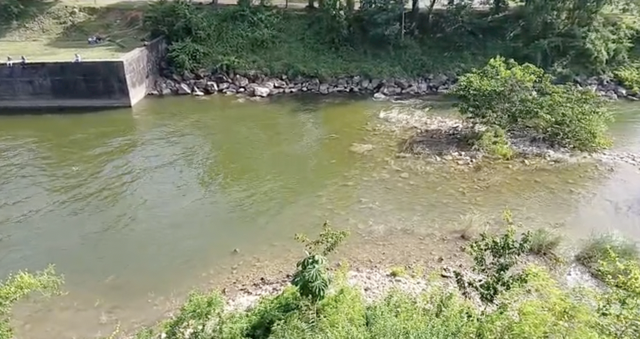
Public concern intensified in December 2025, when residents living in communities surrounding the reservoir began sharing alarming photos and videos on social media showing that the water had turned a bright green colour. In response, the Ministry of Environment carried out water testing and issued a statement attributing the change in water colour to an algae bloom.
Subsequent microbiological studies conducted between December 2025 and January 2026 by the Institute of Microbiology and Parasitology (IMPA) at the Autonomous University of Santo Domingo (UASD), alongside analyses from Franja Laboratory, revealed alarming findings. The results shared publicly by journalist Nairobi Viloria on the programme “Te lo explico” and later reported by Diario Libre, identified high concentrations of bacteria associated with faecal contamination, indicating serious sanitary risks.
The studies also detected Microcystis species, a type of bacteria linked to excessive algae blooms leading to oxygen depletion that can produce potent toxins harmful to human health, livestock, and aquatic life. In addition, other types of microalgae were identified that signal nutrient-rich waters, high organic loads, and ecological imbalance. Together, these findings suggest a reservoir undergoing progressive environmental deterioration. Elevated nitrogen and phosphorus levels were also recorded contributing to harmful algae blooms.
Heavy Metals Also Present
Further analysis by Franja Labs revealed elevated concentrations of heavy metals and toxic substances, including nickel, total chromium, manganese, sulphates, and cyanide, with some exceeding established safety thresholds. These results point to multiple pollution sources, likely including mining activities, industrial discharge, agricultural runoff, and urban waste.
Particularly concerning were nickel levels reaching up to 1,613 mg/L, far above the permissible limit of 0.1 mg/L for surface waters intended to support aquatic life. A 2025 paper published in Environmental Science and Pollution Research also reported elevated levels of copper, arsenic, antimony, aluminum, cobalt, and zinc in the Hatillo Reservoir.
After reviewing the results tested at Franja Labs, the Dominican Association of Chemical Engineers issued a 20-page report expressing significant concerns over the water quality results and recommending continuous monitoring and testing, including of sediment at the bottom the reservoir, and reclassifying the water quality.
The Academy of Sciences of the Dominican Republic also issued a public statement urging authorities to take immediate action. According to the statement, the greenish coloration observed in the reservoir may result from a combination of factors, including the intensive use of fertilizers and agrochemicals, the influx of organic matter, reduced water levels during prolonged drought periods, and possible discharges from nearby mining operations.
Communities Respond to Contamination
Beyond the scientific evidence, the environmental crisis surrounding the Hatillo Reservoir has sparked a strong civic response. Residents of Cotuí have mobilised to demand immediate action, voicing concern over the potential toxicity of the reservoir and its impact on health, livelihoods and the environment.
In March 2026, community members gathered nightly in the town park for candlelight vigils culminating in a large popular march on March 20th. Months later, they are still calling for environmental justice and urgent action to protect and restore the Hatillo Reservoir as a vital source of freshwater for the future.
Photo: Water in the Presa de Hatillo still has a green tint six months after the initial algae bloom. Credit: Ramón Ventura