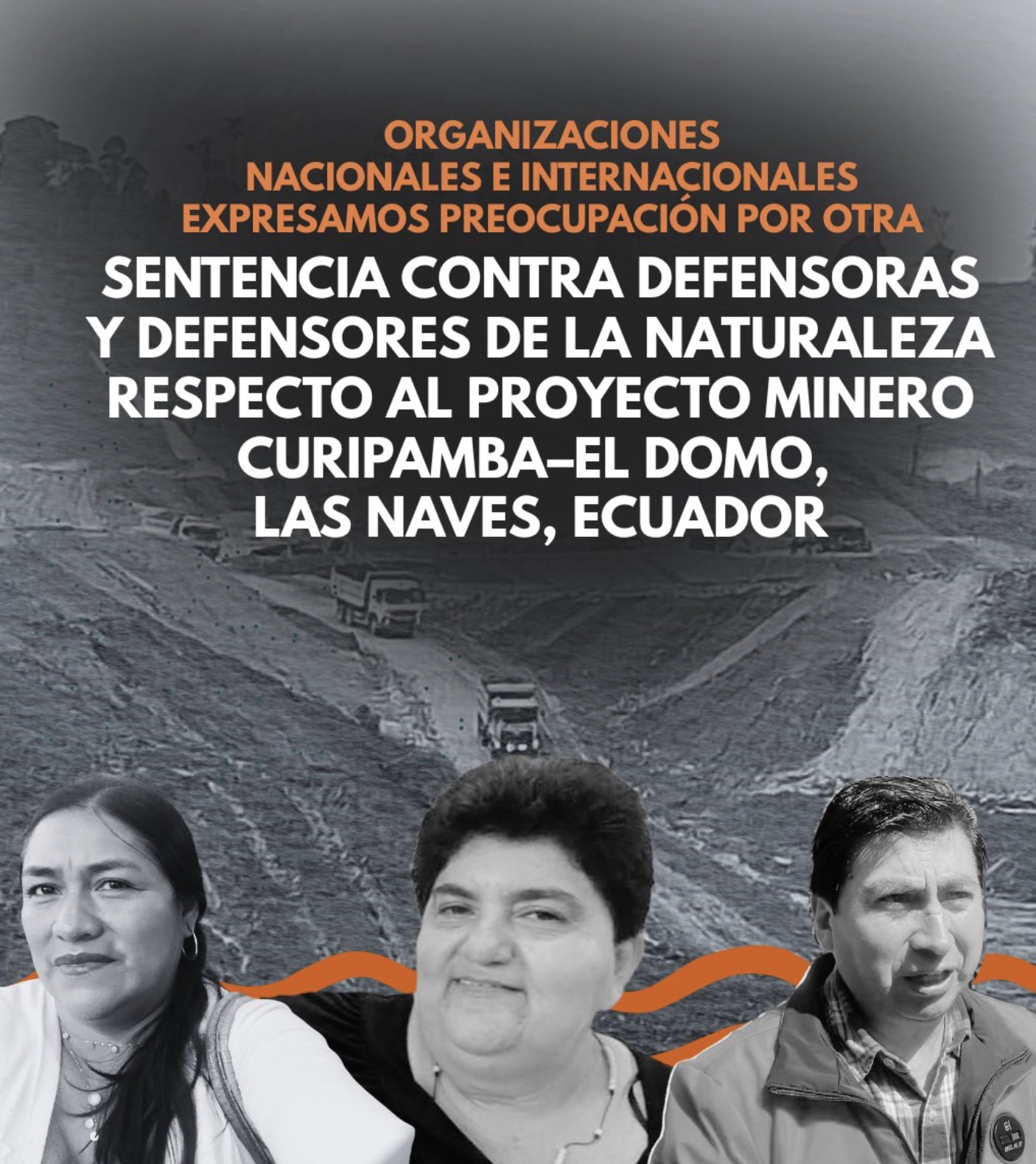
The undersigned national and international human rights and environmental organisations express their deep concern over the sentence by the Criminal Court in Quevedo, Los Ríos province, sentencing defenders Piedad Guaranda, María Ortega and Wilfrido Escobar to four (4) years in prison and the payment of fifteen basic salaries. This judicial decision punishes defenders of water and land and intimidates communities that protect life and nature.
The sentence is part of a pattern of criminalisation against environmental and nature defenders who have denounced the risks and impacts associated with the Curipamba–El Domo mining project (Las Naves, Bolívar), operated by Curimining S.A., owned by the
Canadian companies Silvercorp Metals Inc. and Salazar Resources Ltd. Currently, 32 defenders are facing criminal charges at various stages in the provinces of Bolívar and Los Ríos, which demonstrates the use of the criminal justice system to control, wear
down, break the fabric of community organisation, and restrict the work of defending rights.
The persecution is systematic; one example is the case of Wilfrido Escobar, who was acquitted in one of his trials on 11 December 2025 in the second instance. Meanwhile, in another trial he was again criminalised with a conviction on 23 February 2026. Similarly, in the cases of Piedad Guaranda and María Ortega, there is no evidence to initiate investigations, legal proceedings, or pass sentences that support the charges against them. However, this use of criminal law to limit the exercise of the defence of environmental rights makes a State of rights and justice unsustainable.
It is also alarming that on 23 February 2026, two hearings were scheduled for two different cases linked to the same socio-environmental conflict, raising suspicions about a possible strategy of simultaneous pressure. We note that the first hearing was suspended by the Court itself, increasing procedural uncertainty and the strain on the defenders and their communities.
This ruling also comes in a worrying political context. Serious allegations of lack of judicial independence have been widely known and documented. This includes pressure on judges, scandalous irregularities in the appointment of authorities - such as the heads of the Public Prosecutor's Office and the Judicial Council - as well as statements by the President of the Republic himself questioning the public demand for judicial independence. It is also widely known that the Nobis Group, led by Isabel Noboa, aunt of the current President of Ecuador, Daniel Noboa, has maintained shareholdings in companies linked to the Curipamba–El Domo project, raising serious questions about conflicts of interest at a time of an escalated territorial conflict.
At the same time, the country is undergoing a government push to facilitate international mining investments, including the Bill for the Strengthening of Strategic Mining and Energy Sectors submitted by the Executive on 28 January 2026. The Executive has been questioned for proposing to replace the environmental licence with an authorisation defined according to "risk" by a technical committee. Many voices have warned that this redesign could weaken environmental protection mechanisms and standards for collective rights and nature, including guarantees of prior consultation and environmental consultation.
This is even worse considering that the government is set to sign an FTA with Canada "in the first or second quarter of this year," according to the Ministry of Production, Foreign Trade and Investment. As stated in its chapter on investments, the FTA's main objective is to grant legal privileges to Canadian investments (mainly focussed on mining) such as the ability to sue Ecuador in international arbitration courts. This amounts to disrespecting the will of the people, who overwhelmingly said NO to international arbitration in the April 2024 referendum, and violating Article 422 of the Constitution of Ecuador, which prohibits the State from ceding sovereign jurisdiction to international arbitration bodies in disputes with private individuals or legal entities.
We recall that the Ecuadorian State has an obligation to guarantee the right to defend rights, freedom of expression and participation, due process and judicial independence, protecting those who defend nature and human rights.
We demand that the Ecuadorian State:
- Guarantees a constitutional state of rights and justice for defenders of nature.
- Guarantees due process and access to effective judicial review.
- Ceases the criminalisation of nature defenders linked to the Curipamba–El Domo mining project and to refrain from using criminal law to inhibit territorial defence.
- Investigates possible conflicts of interest, undue pressure or coordination in an independent and impartial manner.
- Implements protection measures for prosecuted defenders and their families, and guarantees national and international observation at upcoming hearings.
- Provides all information on the negotiations between the governments of Ecuador and Canada regarding the FTA so that social and environmental organisations can analyse its effects on human rights, collective rights and nature; and that Indigenous peoples are consulted on whether or not we agree with the validity of this treaty.
We demand that the Canadian Embassy in Ecuador and Canadian authorities:
- Implement the "Voices at Risk: Canada's Guidelines on Support for Human Rights Defenders" and publicly support defenders and their legitimate work in defending human rights, their territories and water sources. This can take several forms, including meeting with representatives of affected communities, observing trials against criminalised defenders, and publicly expressing concern to Ecuadorian authorities about the multiple cases of harassment, criminalisation, and conviction of defenders.
- Do not approve or ratify the Canada-Ecuador Free Trade Agreement, especially if it includes the arbitration mechanism. This agreement threatens the rights of Indigenous peoples and peasant communities, their territories and nature.
We demand that Curimining S.A., a subsidiary of Silvercorp Metals Inc. and Salazar Resources Ltd:
- Immediately ceases the criminalisation and harassment of defenders and communities affected by the Curipamba - El Domo project.
- Suspends its activities and assess the environmental impacts, especially on water sources, in accordance with Ecuadorian legislation and international standards.
Defending water, territories and nature is a right, not a crime.
Signatories:
- Frente de la defensa del agua, la vida y la naturaleza, Las Naves
- Alianza por los Derechos Humanos en Ecuador
- Junta de Riego y Drenaje Suquivi-Cumanda
- Fecab Brunari - Gobierno Comunitario Provincial del Pueblo Waranka
- Proyecto Dulcepamba
- MiningWatch Canada
- INREDH
- Quito Sin Mineria
- Frontline Defenders
- Ecuador No te Dejes
- Environmental Defender Law Centre