Brief

Submission for the Government of Canada’s consultation on due diligence and civil liability measures to eliminate forced labour in supply chains

MiningWatch Canada advocates for policies and legislation in Canada to ensure that mining companies carry out due diligence to prevent harm that may be caused or contributed to by their operations and we seek effective access to remedy in Canada through both non-judicial mechanisms and judicial means. Given our organizational mandate, the ongoing use of forced labour in the operations of Canadian mining companies, their subsidiaries or contractors, is of serious concern for MiningWatch Canada.
Publication

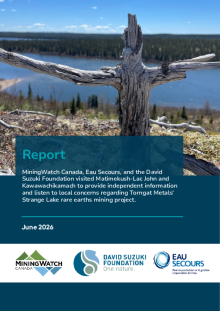
Delegation to Matimekush-Lac John and Kawawachikamach Regarding Torngat Metals' Strange Lake Project

At the invitation of Kamamuit Papakassikᵘ (“the Assembly” of Papakassik, the Master of the Caribou), a delegation visited the Innu community of Matimekush–Lac John and the Naskapi community of Kawawachikamach to provide independent information about the Strange Lake mining project being developed by Torngat Metals. The delegation was made up of hunters and custodians of Nitassinan – the territory of the Innu Nation – as well as representatives from MiningWatch Canada, Eau Secours, and the David Suzuki Foundation.

Guest Publication

Critical Questions about the Risks of Radiation Toxicity from Deep Sea Mining

Report published by the Deep Sea Mining Campaign. 

Deep sea mining (DSM) risks releasing unregulated radioactivity directly into global ocean commons and marine food chains. There are at least 10 critical knowledge gaps that must be answered before DSM is permitted. We call on the science community and regulatory authorities to undertake a focused investigative effort.

Publication

Annual Report 2025

This year has been a year of contradictions. In the midst of US tariffs and tension with Canada’s largest trading partner, the federal government and the governments of B.C., Ontario, Québec, and Nova Scotia all passed or tabled legislation aiming to deregulate the mining sector and incentivize more mining projects. Both in Canada and globally, we saw a worrying trend of dismantling environmental protections, limiting democratic participation, and trampling on Indigenous rights to consent in order to fast-track mining projects in the name of national security and economic growth.

Publication

Implications of The Metals Company Pre-Feasibility Study for Next Steps by the Company

The Metals Company (TMC), a publicly-traded company on the NASDAQ, has released a Pre-Feasibility Study prepared by AMC Consultants Pty Ltd (2025) for the mining of deep-sea nodules in the Clarion Clipperton Zone in the northeast Pacific Ocean. TMC is seeking an exploitation permit from the US National Oceanic and Atmospheric Administration (NOAA), rather than from the International Seabed Authority (ISA), which has not yet developed the regulatory framework for issuing exploitation permits.

Publication

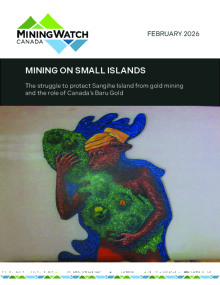
Mining on Small Islands: the Struggle to Protect Sangihe Island and the Role of Canada's Baru Gold

This report is based on fieldwork carried out by Catherine Coumans, Asia Pacific Program Coordinator at MiningWatch Canada, on Sangihe Island in November 2025. It details the issues related to mining on small islands in Asia Pacific and the ongoing struggle by the grassroots Save Sangihe Island (SSI) coalition to protect Sangihe Island from gold mining by Canadian company Baru Gold Corp. The report discusses: 

Guest Publication

Brief on Québec's Bill 5 aimed at fast-tracking priority projects and projects of national importance

The purpose of this brief is to present an analysis of the proposed Bill to accelerate authorizations required for the completion of priority and national-scale projects (PL5). The brief was produced by Eau Secours, with the support of the Coalition Québec meilleure mine (QMM) and Sept-Îles Sans Uranium (SISUR), and aims to convey our comments and positions regarding the proposed legislation.

The brief is available in french only. 

Brief

UN Brief: Report on the Violation of the Rights to Indigenous Self-Determination and Democratic Participation of Indigenous Peoples in Canada Due to “Fast-Tracking” Legislation for Major Projects

This Shadow Report to the United Nations Human Rights Committee with Respect to the Seventh Periodic Report of Canada was developed by the Environmental Justice and Sustainability Clinic, a public interest legal clinic and experiential education initiative housed at Osgoode Hall Law School in Toronto, and co-submitted with MiningWatch Canada and Legal Advocates for Nature's Defence (LAND).
Publication

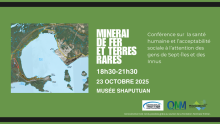
Event Report | Iron Ore and Rare Earth Elements: Conference on Health and Social Acceptability for Residents of Sept-Îles and the Innu People

In response to an invitation from the Groupe Citoyens de Sept-Îles (Sept-Îles Citizens' Group), MiningWatch Canada and the Coalition Québec meilleure mine held an information evening on Tuesday, October 23, 2025, at the Shaputuan Museum in the Innu community of Uashat mak Mani-utenam on human health and social acceptability concerning critical minerals, particularly iron ore and rare earth elements.
Guest Publication

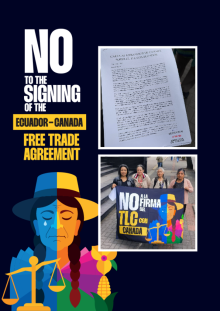
The Ecuador-Canada Free Trade Agreement and the Referendum in Ecuador: An Attack on Constitutional Protections

This paper by the Transnational Institute examines how and why Investor State Dispute Mechanisms (ISDS) were included in the new Ecuador Canada free trade agreement (FTA) despite being prohibited by the Ecuadorian constitution, and makes connections between the FTA and the upcoming referendum in Ecuador.
Brief

A Review of Key Environmental Considerations Related to Denison Mines’ Wheeler River Uranium Project

Denison Mines’ Wheeler River Project would constitute the first-ever use in Canada of in situ leaching (ISL), to extract uranium from an ore body, and the first attempt anywhere to use “freeze wall” technology to limit contaminant spread from an ISL mine. Our review has identified important gaps and shortcomings in the Environmental Impact Statement and the CNSC Staff Submission recommending licencing of the project related to the proposed ISL/freeze wall process and related issues.

Presentation

Iron ore and rare earths: Conference on human health and social licence for citizens of Sept-Îles and the Innu people

In response to an initiative by the Sept-Îles Citizens' Group, MiningWatch Canada and the Coalition Québec meilleure mine held an information evening on human health and social licence concerning critical minerals, particularly iron ore and rare earth elements. The evening aimed to provide the public with an independent overview of current and future mining development in the Sept-Îles region. 

Publication

Between flaws, setbacks, and timid progress: Findings after 25 years of mining-related consultations

Over the course of 25 years accompanying mining-affected communities in Canada and globally, MiningWatch Canada has observed a pattern of rights violations in the ways governments and the mining industry purport to consult with those most affected. This article briefly outlines several conditions required to guarantee the rights of civil society to participate in meaningful consultation processes that are legal, dignified, effective, and predictable for all. Beyond these conditions, we underscore that the priority of governments must be on guaranteeing the rights of Indigenous Peoples to free, prior, and informed consent as enshrined in the United Nations Declaration on the Rights of Indigenous Peoples when it comes to mining projects in their territories.
Brief

Prospective brief on the omnibus bill on regulatory relief from Quebec's Ministry of Economy coming this fall

These comments are submitted to the Quebec Ministry of Economy, Innovation, and Energy after consultation with our members and interested partners. They concern the annual omnibus bill on regulatory relief announced by the Quebec government. Our discussions with the office of the Minister for the Economy indicate that the omnibus bill is expected to be tabled during this fall's parliamentary session.
Brief

Comments Submitted to the IAAC on the Troilus Mining Project (Impact Assessment)

These comments (in French only) are submitted as part of the assessment of Troilus Gold’s Troilus gold and copper mining project in Eeyou Istchee in Northern Quebec before the Impact Assessment Agency of Canada, following consultation with our members and partners interested in assessing the project’s impacts. More specifically, we ask the Impact Assessment Agency of Canada not to authorize the Troilus mining project as submitted.
Brief

Comments Submitted to the IAAC on the Mont Sorcier Mining Project (Guidelines)

These comments (in french only) are submitted as part of the assessment of Voyager Metals' Mont Sorcier mining project in Eeyou Istchee in Northern Quebec before the Impact Assessment Agency of Canada, following consultation with our members and partners interested in assessing the project's impacts. More specifically, we ask the Impact Assessment Agency of Canada to improve the analytical framework for the assessment of the mining project under review. We invite the IAAC to include in the guidelines a series of questions on the analysis of the cumulative impacts of mining in the area where the Mont Sorcier project is seeking to establish itself.
Publication

Report: Impacts of Nouveau Monde Graphite's exploration work on water in Haute-Matawinie

Community and environmental groups have prepared an important report on the impacts of mining exploration activities by Nouveau Monde Graphite (NMG) in Matawinie. Following an independent community environmental monitoring campaign, the report identifies numerous cases of heavy metal concentrations in watercourses that exceed environmental protection criteria, likely attributable to exploration activities.

Publication

Annual Report 2024: Impact Stories

Our annual report provides some key impact stories from MiningWatch's work in 2024, with additional information about our financial position in 2024.

This year marked a milestone for MiningWatch. Celebrating our 25th anniversary provided an important opportunity for reflecting on the reasons MiningWatch formed when we first opened our doors in 1999, the struggles we’ve supported, the relationships we’ve built along the way, and the immense challenges that lie ahead. 

Brief

Submission on Bill 5, the Protect Ontario by Unleashing our Economy Act

We find the Act as a whole to represent a disturbingly unaccountable and anti-democratic initiative, in that many of its provisions either bypass, undo, or override established processes, reserving decision-making authority to Ministers or Cabinet and removing those decisions from the purview of the Legislature or any other deliberative and publicly-accountable body or process.

Guest Publication

Strategic decarbonisation of the Canadian iron and steel industry: A worker-centered path to cut emissions, increase value added and strengthen global supply chains

The global steel, iron and metallurgical coal industry is emission intensive: the Canadian steel industry contributes to 2 percent of national emissions. Many emission-intensive Canadian steel mills either do not have plans in place, or are experiencing delays and a lack of clarity about the path to reaching net-zero emissions by 2050  – which is both a government and Canadian Steel Producers Association (CSPA) target.

Publication

Reflections on Legal Proceedings in Canada against Barrick Gold Regarding the North Mara Gold Mine in Tanzania

Between 2022 and 2024, Indigenous Kuria from villages surrounding North Mara Gold Mine in Tanzania filed cases in Canada against Barrick Gold Corporation for alleged human rights abuses in and around the North Mara mine. MiningWatch Canada attended the hearings in Toronto and has prepared this report where we: 

Brief

Centering Human Rights in the Rush for Critical Minerals

MiningWatch Canada makes a submission to the UN Special Rapporteur on Climate Change, to inform the rapporteur’s upcoming report on “Human Rights in the Life Cycle of Renewable Energy and Critical Minerals.” 

This submission highlights several examples of human rights violations linked to mining for critical minerals, from initial claims staking to exploration, exploitation, and recycling. While our focus is on mining in Canada and the activities of Canadian mining companies abroad, these violations are common globally. 

Brief

Comments on NPRI (National Pollutant Release Inventory) Facilities in Basse-Ville de Québec

In Canada, the National Pollutant Release Inventory (NPRI) is the means by which Canadians can access information on pollutants released into the environment from emitting companies. It helps Indigenous Nations, governments, scientists and civil society identify priorities for action to protect public health and the environment. 

Public access to the NPRI is through its web page. 

Publication

Radioactive Contaminant Reporting and the National Pollutant Release Inventory (NPRI)

The purpose of a public pollutant release and transfer registry such as the NPRI is transparency, responding to the principle of Community Right to Know, that is, the right of people to know what pollutants could potentially affect them so that they can make risk-informed decisions and take appropriate action – or demand appropriate action from facility operators and authorities – including in case of emergency. 

Publication

Mine Security - Crossing Boundaries, Abusing Rights

The role of mercenaries, mercenary-related actors and private military and/or security companies (PMSCs) in the exploitation of natural resources.

Submission to the United Nations Working Group on the use of mercenaries to inform the Working Group's report to be presented to the 60th Session of the Human Rights Council in September 2025.

This submission updates and expands on MiningWatch Canada’s 2019 submission to the United Nations Working Group on the use of mercenaries with a focus on: 

Publication

Analysis on Bill 63 in Quebec, An Act to Amend the Mining Act and other provisions

On May 28, Québec’s Minister of Natural Resources and Forests, Maïté Blanchette Vézina, tabled Bill 63, an Act to amend the Mining Act and other provisions. The Coalition Québec meilleure mine (QMM) carried out an exhaustive analysis of the bill. In this brief, we present our general comments and proposed amendments. A detailed article-by-article analysis of the bill is available in the French version of this brief, originally published in September 2024 and available online.  

Guest Publication

Giant Evictions, Giant Profits

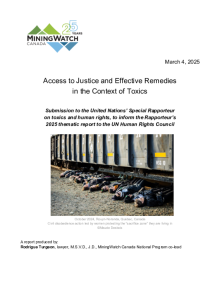
Kibali is Africa’s largest gold mine. It sits in the northeastern province of Haut-Uele in the Democratic Republic of Congo, next to a town called Durba. The presence of this “gold giant” has dramatically transformed this remote area of Congo, a country beleaguered by extreme poverty despite its wealth in natural resources, a situation in part caused by corruption, poor governance, and centuries of international exploitation and intervention. In a three-year investigation, PAX found overwhelming evidence that the expansion of the Kibali mine has entailed large-scale dispossession and violence affecting local communities.
Publication

25 Years: A Bedrock for Mining Justice

MiningWatch Canada launched as a pan-Canadian initiative on April 1, 1999, on the heels of a decade that saw an unprecedented global expansion of mining brought about by economic globalization. Indigenous, environmental, social justice, and labour organizations came together with different backgrounds and experiences to respond to threats posed by irresponsible mining practices in Canada and around the world.

Guest Publication

ELAW: Preliminary Comments on Panama Cobre find Dam at Serious Risks of Failure

Experts from the Environmental Law Alliance Worldwide (ELAW) say First Quantum’s Cobre Panama tailings dam is at very serious and imminent risk of failure due to internal erosion and a lack of proper monitoring. ELAW's report analyzes the Ninth Monitoring Report, presented by Minera Panama, a subsidiary of First Quantum Minerals that operates the Cobre Panama mine, in September 2024, together with other documents that were provided by the Ministry of Environment to ELAW experts who visited Panama in November 2024. 

Brief

Reported Violence against Indigenous Kuria by Mine Police at Barrick Gold’s North Mara Gold Mine during 2023-2024

This year, MiningWatch gathered information on alleged violence against Kuria villagers in 2023 and 2024 carried out by police assigned to the mine. We received information on 28 cases and conducted interviews with alleged victims and family members of those who have been killed. The 28 cases include villagers who have been shot and killed, shot and survived, beaten to death, arrested and tortured, and maimed in a life-altering way through being hit by a teargas canister.

Publication

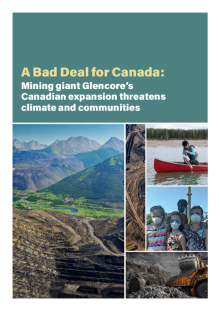
A Bad Deal for Canada: Mining giant Glencore’s Canadian expansion threatens climate and communities

Global commodity trading and mining giant Glencore, a notorious corporation with a long and steady record of irresponsible behaviour, was just approved to dramatically expand its presence in Canada by taking possession of four massive coal mines in British Columbia.

This report looks at some of the reasons there is a great deal to worry about. Among them are significant climate and environmental risks, and Glencore’s dismal track record on human rights, environmental protections, climate, and corruption.

Brief

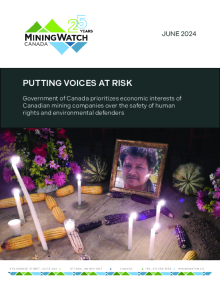
Putting Voices at Risk: Brief to UN Special Rapporteur Mary Lawlor on Canada's support for mining over human rights

To accompany a meeting with UN Special Rapporteur on the situation of human rights defenders, Mary Lawlor, we provide six case studies spanning 17 years that demonstrate Canada's failures to respect human rights when it comes to mining. The first two case studies precede Canada’s adoption in 2016 of Voices at Risk: Canada’s Guidelines on Supporting Human Rights Defenders (Voices at Risk). Events outlined in the four subsequent case studies take place after the adoption of Voices at Risk.

Publication

Solaris Resources: Request to Investigate Failure to Disclose Material Information

The Shuar Arutam People (PSHA) filed a complaint against Solaris Resources Inc. (TSX: SLS) before the British Columbia Securities Commission over its failure to continuously disclose material information to shareholders regarding its Warintza mining project which overlaps PSHA’s titled territory. In spite of PSHA's explicit and continuous rejection of the Warintza project, Vancouver-based Solaris has kept moving forward with its mining plans in the Amazon, one of the most biodiverse areas on the planet.

Guest Publication

State of Deception

A fact-finding report on El Salvador’s detained water defenders, the potential return of environmentally destructive mining, and the state of human rights under the Bukele administration. Report Co-Authors: Alejandro Artiga-Purcell, Robin Broad, Pedro Cabezas, John Cavanagh, Bernie Hammond, Manuel Perez-Rocha, Angela Sanbrano, Heather White, Ross Wells, and Scott Wright.
Publication

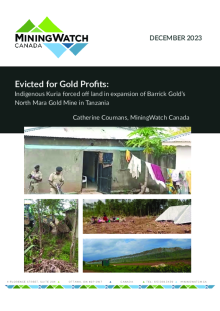
Evicted for Gold Profits: Indigenous Kuria forced off land in expansion of Barrick Gold’s North Mara Gold Mine in Tanzania

MiningWatch Canada details gross violations of human rights at Barrick Gold's North Mara Gold Mine in Tanzania, as thousands of Indigenous Kuria were forcibly evicted from their lands to make room for the mine's expansion. This latest report was written based on field work conducted by Catherine Coumans in Tarime District, Tanzania, between October and November 2023.
Publication

Impacts of Mining Activities on Water: A technical and legislative guide to support collective action

In Quebec, the media often singles out the mining industry for being a repeat offender. This reputation stems from the bad practices of certain mine developers who have abandoned contaminated mine sites and left Quebec residents on the hook for billions of dollars for restoration, turned rivers red for dozens of kilometres, or have used lakes as dumping grounds for the tailings from iron ore processing plants.

Guest Publication

Review of the Environmental Impact Study for a New Facility for Co-Disposal of Tailings and Waste Rock at the Barrick Gold Pueblo Viejo Mine, Dominican Republic

Mine waste safety expert Dr. Steven Emerman released findings of his independent review of Barrick Gold’s Environmental and Social Impact Assessment for the Naranjo Tailings Storage Facility (TSF), warning that the Canadian mining giant is failing to adequately disclose the environmental and social risks posed by its planned expansion at the Pueblo Viejo mine in the Dominican Republic.

Lighting summary:

Brief

Going Upstream: The impact of industrial mining on the human rights to safe drinking water and sanitation

Brief prepared for the country visit of the UN Special Rapporteur on the human rights to safe drinking water and sanitation, Pedro Arrojo-Agudo.

Since 1999, MiningWatch has provided technical expertise and advocacy support to hundreds of communities across the globe as they assert their rights to safe drinking water and sanitation in the face of imminent and past harm by industrial mining.

Publication

Stop ISDS: Report of the International Mission to Colombia

In May 2023, a delegation of 13 representatives from social and environmental justice organisations from eight countries in the Americas and Europe visited Colombia to share experiences of struggles against the global investment protection regime. The mission also went to learn firsthand about the peoples and ecosystems being threatened by corporate lawsuits, as well as the environmental, social and cultural harms that transnational investments have already caused, particularly in the departments of La Guajira and Santander.