Impacts of Mining Activities on Water: A technical and legislative guide to support collective action
In Quebec, the media often singles out the mining industry for being a repeat offender. This reputation stems from the bad practices of certain mine developers who have abandoned contaminated mine sites and left Quebec residents on the hook for billions of dollars for restoration, turned rivers red for dozens of kilometres, or have used lakes as dumping grounds for the tailings from iron ore processing plants.
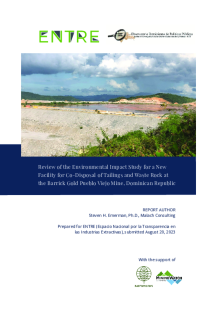
Review of the Environmental Impact Study for a New Facility for Co-Disposal of Tailings and Waste Rock at the Barrick Gold Pueblo Viejo Mine, Dominican Republic
Mine waste safety expert Dr. Steven Emerman released findings of his independent review of Barrick Gold’s Environmental and Social Impact Assessment for the Naranjo Tailings Storage Facility (TSF), warning that the Canadian mining giant is failing to adequately disclose the environmental and social risks posed by its planned expansion at the Pueblo Viejo mine in the Dominican Republic.
Lighting summary:
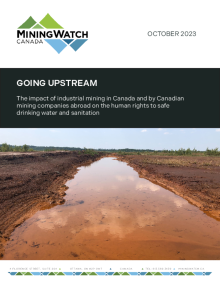
Going Upstream: The impact of industrial mining on the human rights to safe drinking water and sanitation
Brief prepared for the country visit of the UN Special Rapporteur on the human rights to safe drinking water and sanitation, Pedro Arrojo-Agudo.
Since 1999, MiningWatch has provided technical expertise and advocacy support to hundreds of communities across the globe as they assert their rights to safe drinking water and sanitation in the face of imminent and past harm by industrial mining.
Contemporary Forms of Slavery and the Canadian Mining Industry
MiningWatch Canada submitted a brief to the UN Special Rapporteur on Contemporary Forms of Slavery, ahead of Professor Tomoya Obokata's country visit to Canada.
Stop ISDS: Report of the International Mission to Colombia
In May 2023, a delegation of 13 representatives from social and environmental justice organisations from eight countries in the Americas and Europe visited Colombia to share experiences of struggles against the global investment protection regime. The mission also went to learn firsthand about the peoples and ecosystems being threatened by corporate lawsuits, as well as the environmental, social and cultural harms that transnational investments have already caused, particularly in the departments of La Guajira and Santander.
Comment on the Draft Assessment Report for the Cariboo Gold Project
This is MiningWatch Canada's submission to the British Columbia Environmental Assessment Office, commenting on the draft final assessment report for Osisko Development Corporation (ODV)’s Cariboo Gold Project in Wells, British Columbia.
Petition Against Canada for Violations of the Right to Life and Other Rights of Mariano Abarca
In June 2023, the Justice and Corporate Accountability Project (JCAP) submitted a complaint to the Inter-American Commission on Human Rights on behalf of the family of Mariano Abarca. Mr. Abarca was a beloved community leader and human rights defender who was murdered with impunity on November 27, 2009, in Chiapas, Mexico. Mr. Abarca was killed for defending community rights in relation to the “Payback” mining project, owned by Canadian company Blackfire Exploration Ltd. (“Blackfire”). The complaint makes the case for Canada’s legal accountability for human rights abuse linked to its extractive industry overseas.
Submission to the Environmental Registry of Ontario re: Bill G71, the Building More Mines Act, 2023
This submission on Ontario Bill 71, the proposed Building More Mines Act, observes that the government has brought forward a proposal that has not been broadly consulted and discussed, if it has been discussed at all other than with the mining industry. As a result, the proposed amendments to the Mining Act are unlikely to meet their stated purposes.
Canada’s Systematic Failure to Fulfill its International Obligations to Human and Environmental Rights Defenders Abroad
Corporate accountability experts sent a 30-page submission to the UN Human Rights Council ahead of its April 2023 Universal Periodic Review of Canada, denouncing Canada for its continued diplomatic support of mining companies over the safety of human rights and environment defenders (HRDs).
Submission Regarding a Possible Canada-Ecuador Free Trade Agreement
MiningWatch Canada submits our response to the Canadian government, as part of a consultation with civil society on a potential Free Trade Agreement with Ecuador. We are concerned about a lack of transparency in this process for our partners in Ecuador, who were unaware or informed about the consultation process.
Canada’s Mining Dominance and Failure to Protect Environmental and Human Rights Abroad
Harm caused or contributed to by Canadian mining companies, their subsidiaries and contractors overseas is widespread globally and persistent. It includes environmental degradation that will persist for hundreds of years, a wide range of human rights harms, abuses of Indigenous rights, as well as negative economic and financial impacts at local and national levels. Together, these impacts have serious and long-term repercussions on local and national development.
Summary: Lithium Mining in Mexico - Public interest or transnational extractivism?
In Mexico, the government promotes the exploitation of lithium as part of an effort to strengthen national sovereignty, justifying mining by designating lithium extraction as being in the public interest. But what is being promoted as positive and necessary for the country's development is in fact a project strongly tied to private capital – one that poses high risks to the public treasury, while being based on the dispossession, destruction and militarization of the territories where this mineral is located.
Reporting of Toxic Substances Released by Mining under the NPRI (National Pollutant Release Inventory)
This report looks at three examples of the application of the NPRI in the mining sector: the 2013 Obed Mountain coal mine spill in Alberta, the 2014 Mount Polley mine spill in British Columbia, and the Key Lake uranium mine and mill in Saskatchewan. These three cases show both some of the utility of the NPRI and some of its limitations in practical applications to support public interest research, policy development, and regulation.
The Two Faces of Canadian Diplomacy: Undermining Human Rights and Environment Defenders to Support Canadian Mining
Globalized industrial resource extraction is unsustainable from an environmental and social perspective, and Indigenous peoples are often on the front lines of alerting humanity to the resulting harms. Community members and their allies become environment and human rights defenders (HRDs) when they publicly allege harms on the part of state or company actors. As extraction intensifies around the world, so has the criminalization, threats, attacks, and even killings of HRDs. International bodies now regularly refer to this situation as a global crisis.
Comments on Proposed Federal Approval Conditions for the Marathon Palladium Mine
MiningWatch Canada has submitted comments on the draft federal environmental assessment conditions for the Marathon Palladium Project, where we express deep concern that the project is advancing in spite of the projected negative environmental effects and argue that a much more comprehensive and prescriptive set of conditions is required.
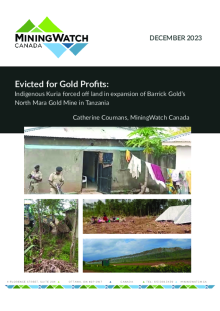
“He was murdered”: Violence against Kuria High after Barrick Takeover of Mine
This report presents findings from research undertaken by MiningWatch Canada in North Mara, Tanzania, in September 2022. The issues addressed in this report have all occurred since Barrick’s September 2019 takeover of mine ownership and under Barrick’s CEO Mark Bristow. Findings are based on information provided by, among others, elected officials, community leaders, victims of violence by police who receive direct financial and other benefits from the mine (mine police), and family members of those who have perished as a result of excess use of force by mine police, as well as information provided by victims of violent and inequitable forced evictions, the legality of which is questionable.
Canada’s Critical Minerals Strategy – A Response to the Department of Natural Resources Discussion Paper
Natural Resources Minister Jonathan Wilkinson released a discussion paper on Canada’s Critical Minerals Strategy at the annual Prospectors and Developers Association of Canada (PDAC) convention earlier this year. This is a response to that document.
Coalition Against the Mining Pandemic - Africa Synthesis Report: People in Lockdown, Extractives in Business
Covid-19 has created deeper inequalities and increased poverty while richer households and nations have begun to recover; the world’s poor and working class continue to absorb its impacts.
The Covid-19 pandemic highlights the relationship between the failures and contradictions of capitalism and the global destruction of nature and deepening socio-economic inequalities. The manner in which Covid-19 continues to unfold reflects the rhythm of existing patterns of exploitation, placing at the centre of its destructive path the world’s already vulnerable people.
Coalition Against the Mining Pandemic - Europe Regional Synthesis Report
This report explores, through research and a series of first-hand accounts, how extractive industries have sought to benefit from the Covid-19 pandemic, advancing mining agendas and shrinking civic space. Key themes are presented throughout case studies in Turkey, Northern Ireland, and Spain. This report was developed by the Europe Coordinating Committee of the Coalition Against the Mining Pandemic.